
Introduction
Strategy is the pursuit of “long-run goals and objectives”.1 How long should a strategy be set at? There are different definitions but a popular framework is the three horizon by McKinsey partners Mehrdad Baghai, Stephen Coley and David White in their Book “The Alchemy of Growth” (Published in 2000). The three horizon framework breaks down strategy into three horizons: Short term (1 Year), medium term (3 years), and long term (5 years). However, with disruption becoming more rapid and frequent, Oxford proposes a broad view of strategy in addition to the long term view. By taking a broad view where the strategist develops scenarios and playbooks for potential changes in the contexts that the business is operating in, they can prepare well to react to changing environments.
Why does strategy matter?
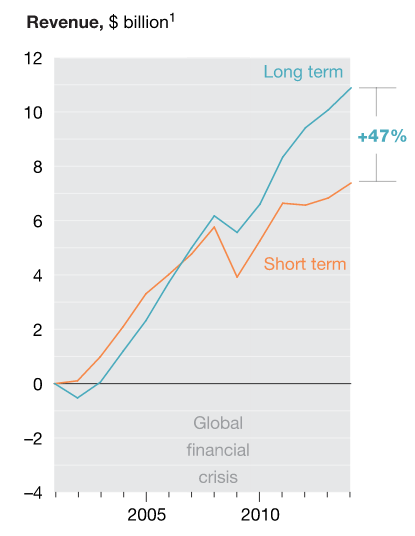
In this paper by McKinsey the difference in financial performance of short term vs long term companies is clear, companies that favor long term objectives consistently outperform companies that focus on short term goals in terms of revenue, market capitalization, and revenue.
Three Horizons Framework
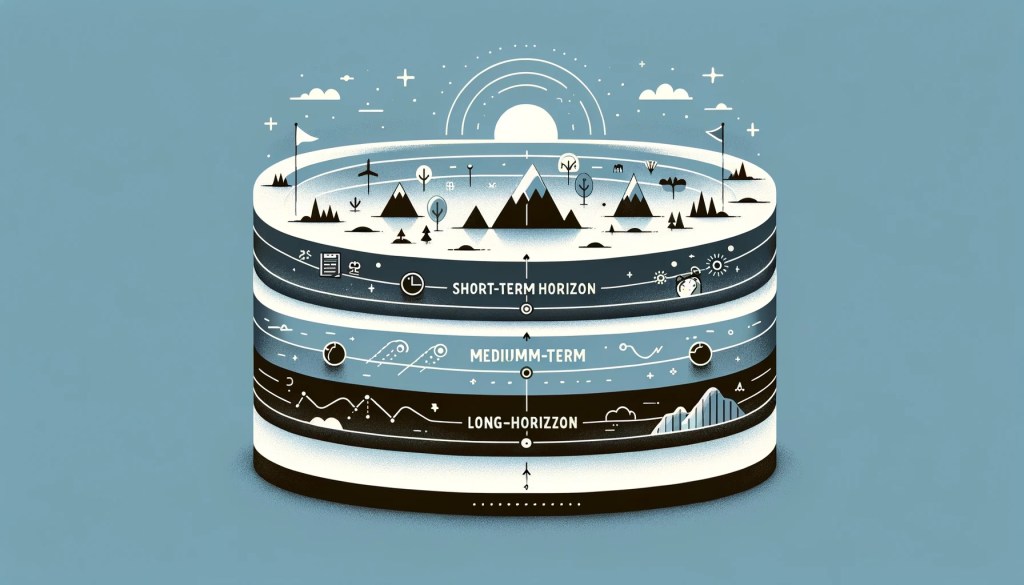
The three horizons is a strategic framework for innovation and growth, offering a structured approach to balancing short-term objectives with long-term vision. By delineating three time horizons, this framework allows organizations to manage current operations, nurture emerging opportunities, and explore transformative possibilities for the future. Developed by management scholars Baghai, Coley, and White in the late 1990s, the three horizons model has since gained traction across industries as a powerful tool for strategic planning and decision-making.
Grounded in the concept of managing different types of innovations concurrently:
- The first horizon represents the core business activities that drive current profitability and efficiency. It involves optimizing existing products and services, as well as refining processes to maintain a competitive edge in the present market landscape.
- The second horizon focuses on extending and scaling emerging opportunities, such as new technologies, business models, or customer segments. This horizon requires experimentation and adaptation to capitalize on potential growth areas while still managing risk.
- The third horizon, often considered the most disruptive and uncertain, encompasses envisioning and creating entirely new business models, products, or services that could redefine the organization’s future trajectory. It involves exploring radical innovations, fostering breakthrough ideas, and challenging traditional assumptions to stay ahead of industry disruption and maintain relevance in evolving markets. By actively managing all three horizons, organizations can effectively balance present performance with future potential, ensuring sustainable success in an ever-changing business landscape.
| Horizon | Years | Description |
|---|---|---|
| 1 | Short-term (1 Year) | Horizon 1 ideas provide continuous innovation to a company’s existing business model and core capabilities in the short-term. |
| 2 | Medium-term (3 Years) | Horizon 2 ideas extend a company’s existing business model and core capabilities to new customers, markets, or targets. |
| 3 | Long-term (5 Years) | Horizon 3 is the creation of new capabilities and new business to take advantage of or respond to disruptive opportunities or to counter disruption. |
And so strategy in the three horizon model is establishing objectives across all three horizons concurrently and investing in them equally. In my experience starting with a 5-year vision or plan and then breaking it down into yearly objectives is a practical approach to establishing strategy. The 1-year plan is a specific roadmap and focuses primarily on execution. A 3-year plan usually focuses on a product that we know is achievable, has demand, and doesn’t have significant risks. A 5-year plan (or rather vision as the specific execution may change as the plan progresses) has a high risk but also high reward.
We should be mindful of the tendency to become overly absorbed in immediate priorities, thus neglecting the broader perspective and long-term strategies. It’s common to prioritize Horizon 1 objectives, concentrating solely on delivering tangible outcomes, and inadvertently losing sight of the “big picture” and the importance of longer-term horizons. This phenomenon tends to intensify during periods of economic downturns or when facing tight deadlines, making it crucial for organizations to be vigilant. McKinsey has explicitly cautioned against this potential pitfall, emphasizing the need for a balanced approach that encompasses both short and long-term goals to ensure sustained success.
Why do companies fail to focus on horizons beyond horizon 1?
Individual incentives: An integral part of many corporate environments is the presence of annual performance review cycles and the establishment of yearly goals. In this setting, it is not uncommon for individuals to be incentivized to prioritize short-term or partial results, as the repercussions of failing to meet annual goals can significantly impact their potential for performance appraisals and bonuses. This phenomenon transcends various job families, encompassing sectors such as technology, sales, and numerous others. Such circumstances underscore the intricate interplay between individual motivations and the broader organizational context.
Financial markets: Public companies have quarterly and annual objectives. When these objectives, whether they be in the form of Earnings Per Share or revenue, are not met, the market often penalizes the company. This can lead to a short-term focus from investors, where any setbacks are swiftly met with repercussions. An intriguing case is that of Amazon, which for years operated at a loss, causing the market to underestimate its long-term value. This complex dynamic exemplifies the intricate balance between short-term performance and long-term potential in the world of publicly traded companies.
Accelerating Horizon 2 and 3
The division of horizons into future objectives of 3 year and 5 year worked well for the 20th century as the pace of development was relatively slow compared to now. Today disruptions happens much faster than in 5 year increments. Most recently the advent of generative AI and its popularization via ChatGPT is an example of how something that may have been planned for 5 years in the future or beyond has immediately materialized. Companies that can adapt and adopt it quickly are the ones that can take a strategic advantage of it while companies that don’t will lag behind. As harvard business review calls out:
“While traditional analysis suggests that Horizon 3 disruptive innovations take years to develop, in today’s world this is no longer the case. The three horizons are no longer bounded by time. Today, disruptive Horizon 3 ideas can be delivered as fast as ideas for Horizon 1 in the existing product line.”
Steve Blank, Harvard Business Review: McKinsey’s Three Horizons Model Defined Innovation for Years. Here’s Why It No Longer Applies
For companies to adopt horizon 3 innovations faster they can take one of the following approaches:
| Approach | Example | Risk |
|---|---|---|
| Incentivize external resources | NASA and Commercial Resupply Services | Potential cultural mismatch |
| Combine strengths through acquisition | Google buying Android | Risk of culture mismatch |
| Rapidly copy and dominate | Microsoft copying Netscape, Google copying Overture | Risk of missing target due to lack of understanding of customer problem. |
| Innovate better than disrupters | Apple and the iPhone, Amazon and AWS | Difficulty in instilling innovation culture within large organizations. |
Broad View + Three Horizons
To accelerate delivering horizon 3 innovations a company must quickly recognize it. Oxford’s view of strategy takes a broad view in addition to a long term view. The broad view has two key components to ensure companies and executives stay abreast of ongoing changes beyond the immediate industry:
Scenario Planning: Where you plan for 2-3 scenarios that may impact your company using the context surrounding the company. The scenario should address the following key questions:
- What aspects of your organization’s environment are generating a deep sense of uncertainty for you?
- Who might you speak to, or what information could you access, to better understand the range of outcomes of the uncertainty, and how can you work these into your scenarios?
- How might you consider adapting your organization’s strategy to capitalize on new opportunities and ensure that it is robust across your scenarios?
- What key signals do the scenarios suggest you use to track changes in your organization’s environment?
Strategy Playbook: In dealing with the scenarios executives need to prepare a set of plays for how to deal with each scenario. The playbook should address the following questions:
- To execute your strategy, which aspects would be better addressed using a playbook as compared to a plan?
- What “plays” make most sense in different scenarios?
- What options will you create for these plays, to be run as and if necessary?
- How will you monitor developments to provide forewarning as to which play to run?
Conclusion
In a rapidly evolving business landscape, the strategic framework of the three horizons model proves indispensable, offering organizations a powerful tool to juggle immediate priorities alongside long-term vision. Simultaneously managing ongoing operations, nurturing budding opportunities, and exploring transformative possibilities allows companies to ensure sustainable success in the face of industry disruptions.
The importance of long-term strategies is highlighted by research showing that companies prioritizing long-term objectives outperform those fixated on short-term goals. Yet, individual motivations and market pressures often drive a narrow focus on immediate results, potentially undercutting the pursuit of broader, future-oriented strategies.
As the pace of disruption accelerates, the conventional time-bound approach to the three horizons model falls short. Innovations once deemed long-term prospects now manifest at an unprecedented pace, demanding swift adaptation to maintain strategic advantage.
To tackle this challenge, companies can embrace a panoramic view of strategy, integrating scenario planning and strategy playbooks to traverse uncertainties and capitalize on evolving opportunities. By adopting a forward-thinking mindset and actively managing all three horizons, organizations can position themselves for sustained relevance and resilient growth in dynamic markets.
By harnessing the interplay between short-term performance and long-term potential, and pairing the three horizons model with a comprehensive strategic outlook, companies can thrive amidst uncertainty and drive impactful innovation in an ever-changing landscape.
References
- Chandler, A.D. 1962. Strategy and structure: chapters in the history of the industrial enterprise. Cambridge, Massachusetts: MIT Press. ↩︎
 Tech Leader
Leave a comment